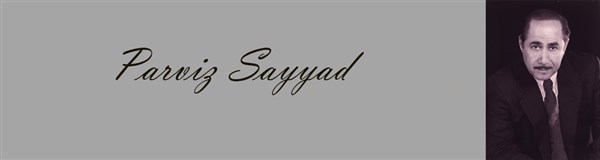
Parviz
Sayyad
Born
in Lahijan in 1939, Sayyad was one of the leading actors and playwrights
during his youth in Iran. In 1960, after the formation of Iran's
National Television, Sayyad and many others from theater joined its cast
and started producing tele-theater shows until 1970. Sayyad and Apick
Youssefian (who later with her daughter Mary Apick played in many of Sayyad's
films) were the leading characters of Iran's first television series, "AMIR
ARSALAN." The show was quite successful and paved the road for Sayyad's
future career in cinema and television.
The
following year Sayyad joined Parviz Kardan in another successful TV series
called "SARKAR OSTOVAR". This is where his famous Samad character
was first formed. Samad became so popular that in 1969 with the help
of Ali Abbasi, Sayyad directed his first Film "Samad
and the Flying Carpet" using the same character. At the same
time he continued producing shows for Iran's National Television.
Some of the most famous ones were Octopus, and DEAR UNCLE NAPOLEON (Taghvaii
1977).
Out
of his homeland, Iran, film critics began acknowledging Sayyad's work when
they saw his first film in exile, THE
MISSION, made in 1984. He, however, had written and directed
more than a dozen films and appeared in most of them as the lead actor,
back home, where he used to be a household name prior to the Islamic Revolution.
International
Film Guide (1977), described him as "An extraordinary popular and vital
member of the Iranian film world", while Film Comment Magazine wrote, "in
much of Sayyad's work, he examines the lives of individual people caught
up in political or social events which are beyond their control.
In DEAD END (1976),
Mary Apick plays a lovesick girl wooed by an eligible young man, only to
find her suitor a SAVAK agent whose mission is to arrest her brother.
In Shahid Saless' celebrated
IN
DER FREMDE (Far From Home) (1975), Sayyad plays the part of a lonely
Turkish immigrant laborer in West Berlin who is met with indifference when
he tries to make friends with his German neighbors.
Sayyad's
professional life is in fact full of paradox and contradictions.
Before the Islamic Revolution, he was one of the leading figures in the
IRANIAN popular cinema, specializing in the role of a country bumpkin baffled
by the ways of the big city. In 1974, he co-founded The New Film
Group, a loose confederation of New Wave filmmakers, and used the money
from his commercial successes to help finance the works of young and talented
directors who could hardly find any backing in the conventional movie market.
One of the last films he made in Iran, DEAD END, has a double distinction;
its star, Mary Apick,
received the Best Actress Award at the 1977 Moscow Film Festival, but the
film was never publicly shown in IRAN, while the Shah was in power.
The former action undoubtedly influenced the latter. The Islamic
Regime's reaction towards this film was not any better, of course.
Although it was the first successful film shown after the Revolution, in
a few months it had to be canned for good. This time, the contents
was not the issue, but that the leading characters appeared in public without
the Islamic veil, Chador!
After
making a film deal in Germany, when the Revolution broke out, Sayyad figured
he would not be welcomed back after his Tehran Little Theater was taken
over by an Islamic radical group. This led him to a tiny Greenwich
Village apartment where he quietly worked towards his Ph.D. at the City
University, while awaiting his family's return to him from Iran; and so
the making of a low budget thriller like film, THE MISSION, became possible.
THE MISSION, described by David Denby of New York Magazine as "the first
Gandhian Thriller", concerns the political awakening of a young assassin
(Houshang Touzie) sent by a Moslem radical group to eliminate a former
government official. It was an official entry in The Berlin Film
Festival, The London Film Festival, and won The Jury Grand Prize at The
Locarno Film Festival (1983).
Inspite
of THE MISSION's overall success, it took Sayyad four years to finance
his second film in exile, CHECKPOINT, with the help of his long time artistic
collaborator, Mary Apick. Meanwhile they produced a play, entitle
Khar
(Donkey) which was based on a short piece that Sayyad had written.
Sayyad,
now working in Los Angeles directing Farsi-language stage plays and TV
shows for the large Iranian exile community there, says that all his movies
- with the exception of one that depicts the lives of an old couple (the
woman wears a chador throughout)- are banned in the Islamic Republic.
"Under the Khomeini regime," he declares, "it seems that any independent
productions are immediately banned, except for propaganda films.
They have a Ministry of Art and Culture that does produce films, but these
hardly ever get shown. At least during the Shah's period, a film
like THE CYCLE, which
was a great movie, could be made. [Sayyad was co-producer of the movie.]
We've forgotten about that period, but when we compare it to the present
regime, it was like living in paradise."
Actor - filmography
Samad Returns From the War
(1988)
Checkpoint (1987)
On Wings of Eagles (1986) TV
Series
Samad Goes to War (1984)
Ferestadeh (1983)
... aka Auftrag, Der (West
Germany)
... aka The Mission
Samad Darbehdar Mishavad -
Samad becomes Homeless (1978)
Samad dar Rah-e Ejdeha - Samad
On the Path of Dragon (1977)
Daie Jan Napelon - My Uncle
Napleon (1976)
Samad Khoshbakht Mishavad -
Samad Gets Lucky (1975)
Zanburak (1975)
Dar Ghorbat (1975)
... aka Far from Home
(International: English title)
... aka In der Fremde (West
Germany)
Asrar Ganj Dareheye Jenni
(1974)
Maslakh (1974)
Mozafar (1974)
Samad Artist Mishavad - Samad
Becomes an Artist (1974)
Samad be madreseh miravad -
Samad Goes to School (1973)
Samad va sami, leila va leili -
Samad & Sami, Leila & Leili (1972)
Sattar khan (1972)
Khastegar (1971)
Samad va Fulad Zereh Deev -
Samad and Fooladzereh, the Monster (1971)
Samad va ghalicheyeh hazrat
soleyman - Samad and The Flying Carpet (1971)
Hasan Kachal (1970)
Octopus (1969)
Sarkar Ostovar (1968)
Amir Arsalan (1967)
Writer, Director and Producer - Filmography
Checkpoint (1987)
Ferestadeh (1983)
... aka Auftrag, Der (West
Germany)
... aka The Mission
Bon Bast (1977)
... aka Dead-End
At the End of Night (1977)
Ghazal (1975) (producer)
Samad khoshbakht mishavad
(1975)
Zanburak (1975)
Mozafar (1974) Samad Artist
Mishavad (1974)
Tabiate bijan (1974) (producer)
... aka Still Life
(International: English title)
Samad be madreseh miravad
(1973)
Sattar khan (1972) (producer)
Khastegar (1971) (producer)
Samad va fulad zereh div (1971)
Faryade dehkadeh (1965)
(producer)
... aka The Cry of the Village
(International: English title)
Plays: Actor, Playwright, Director
1. Parviz Sayyad and His Samad
(1994)
2. Hadi Khorsandi and His Samad
(1998)
3. Samad Goes to War (1990)
4. Samad Returns From War
(1992)
5. Faalgoosh - Eave Dropper
(1989) Produced in Los Angeles
6. The Donkey - Khar - (1983) -
Produced in New York
7. Jaan Nesar - (1981) Produced
in New York - Colombia University
Books: Writer
The Obstacles of Exiled Cinema
(1995)